
Awe, Not Excess: The Market Signal Luxury Travel Can’t Afford to Miss

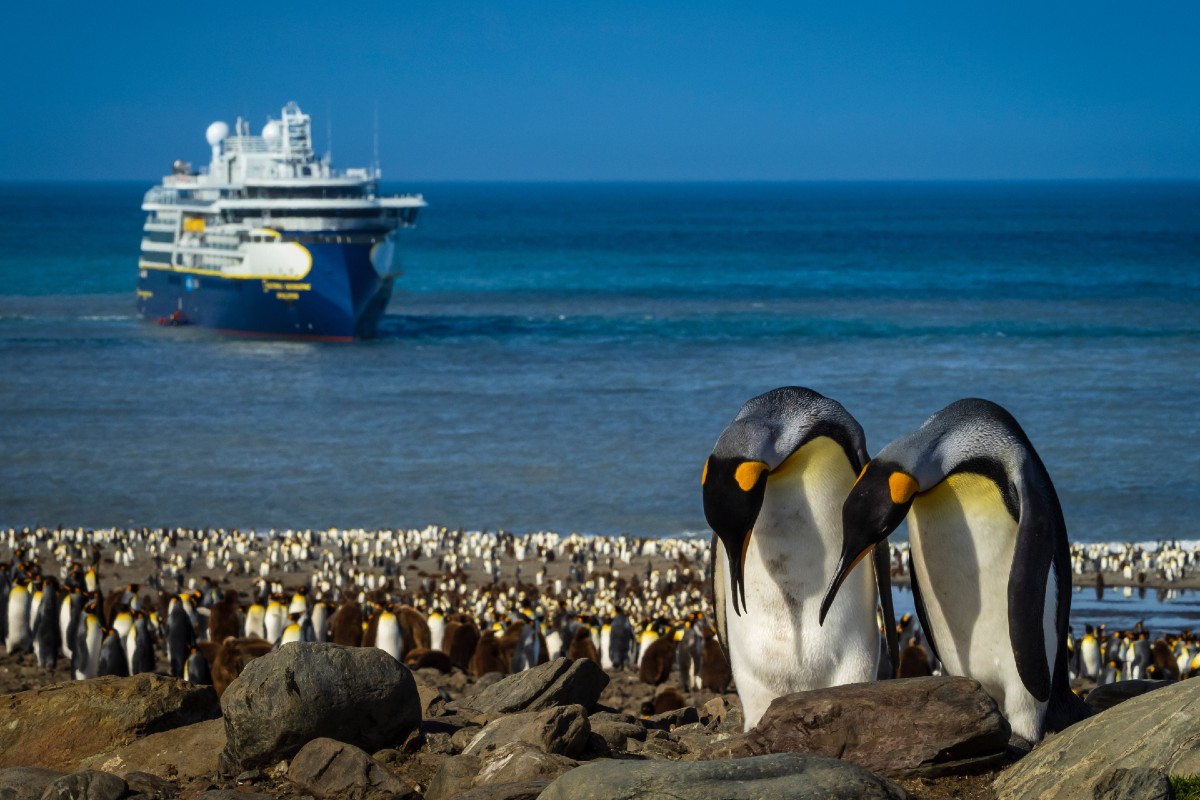
Photo Caption: King Penguins courting with National Geographic Resolution offshore in St. Andrews Bay, South Georgia
Skift Take
The affluent traveler's definition of luxury has shifted faster than most operators realize. Lindblad Expeditions is proof that the brands built around depth of experience and purposeful discovery are gaining a competitive edge.
This sponsored content was created in collaboration with a Skift partner.
The most valuable luxury travelers are changing what they want from a trip. Frequent, high-spending, and difficult to win back once lost, these customers are redefining what a trip needs to deliver. More than half of affluent travelers now consider authentic cultural experiences a primary factor in their definition of luxury, according to Skift Research. This is an established market reality, not an emerging preference. For luxury travel operators still leading with thread counts and star ratings, the window to reposition is narrowing.
Natalya Leahy, CEO of Lindblad Expeditions Holdings, has watched that shift accelerate during her tenure. In 2025, the company carried roughly 60,000 travelers to some of the world’s most remote places by land and sea, posted $771 million in revenue — a 20% year-over-year increase — and recorded the highest guest satisfaction scores in its history. The numbers make a pointed argument: operators who have built their product around depth of experience, not surface-level access, are seeing their approach validated in the marketplace.
“Our guests are sophisticated, curious, and exceptionally well-traveled,” Leahy said. “They’re no longer collecting destinations — they’re seeking experiences that are authentic, transformative, and leave them seeing the world differently.”
Redefining What Luxury Delivers
The conventional luxury travel framework of five-star properties, white-glove service, and gala dinners still has a market. But the affluent traveler segment that’s growing fastest is operating on a different set of criteria.
“Luxury today isn’t about having more,” Leahy said. “It’s about experiencing something few people ever do. It’s being welcomed into someone’s home for dinner, exploring places most travelers never reach, and returning home with a deeper understanding of the world and the people who call it home.”
That redefinition raises a strategic question for anyone building or selling a high-end travel product: what does the experience deliver that travelers cannot source elsewhere? Exclusivity was once tied to price and property. Increasingly, competitive advantage comes from expertise, unique access, and the quality of execution in the field.
“As technology, AI, and automation become more pervasive, affluent travelers will place even greater value on experiences that are personal, authentic, and rooted in the present moment,” Leahy said.
As the pace of digital saturation accelerates, demand is rising for its opposite: full sensory presence in a remote place, guided by people who understand it deeply. Expedition and adventure travel are no longer niche pursuits within luxury travel. Technavio projects the adventure tourism market will grow by roughly 9.4% annually through 2030, underscoring the strength of demand for experiences centered on discovery, learning, and connection — well ahead of broader industry adaptation.
The Operational Model That Makes Depth Possible
For Lindblad, the differentiation is rooted in structure. The company’s expedition model is built around operational flexibility and intimacy that are hard to replicate: ships small enough to reach places that larger vessels can’t access, captains and expedition leaders with the authority to adapt itineraries in real time based on wildlife activity, weather, and conservation conditions, and an open-bridge policy that puts guests inside the decision-making firsthand. That intimacy also shows up in smaller moments, from crew members knowing guests by name to remembering their preferences at every meal.
“We are nimble, and our experienced teams have expertise and confidence to pursue truly unique experiences,” Leahy explained, “opening up places few have ever gone before and quite literally mapping the ocean floor.”
The practical result is an experience shaped by what nature offers rather than by what a fixed itinerary prescribes. Guests might drop anchor to snorkel with a rare sea lion colony, or be woken at midnight because the Northern Lights are visible. The most meaningful moments, Leahy noted, are often the least scripted.
When the Unscripted Becomes the Product
Leahy recounted one expedition to Antarctica — where Lindblad regularly operates as one of the few vessels reaching the continent’s most remote areas — during which the company’s ship was the southernmost passenger vessel in the world for several consecutive days. On a cross-country ski to a glacier, her group encountered Emperor Penguins. The expedition naturalist stopped everyone.
“Francesco smiled and pointed out that we could no longer see the ship. Then, without any plan or ceremony, he invited us to spend a few quiet moments simply taking it all in. We had been greeted by emperor penguins along the way, and now, standing on the Antarctic ice in complete silence, it became one of the most profound experiences of my life. It wasn’t just beautiful — it gave us all a completely different perspective on our planet, its incredible fragility, and our place within it.”
Those field moments are why the National Geographic-Lindblad Expeditions partnership, now more than 20 years old, functions as a meaningful competitive differentiator. Scientists, naturalists, National Geographic Explorers, and storytellers travel on expeditions as active contributors, not add-ons.
“The National Geographic-Lindblad Expeditions difference is shaped by science, deep destination expertise, and commitment that travel can be a powerful driver of positive change,” Leahy said. “This truly sets us apart.”
A Pioneer Building Toward Its Next 60 Years
Lindblad’s claim on expedition travel is built on decades of leadership in the category. Lars-Eric Lindblad, father of the company’s founder Sven Lindblad, helped define modern expedition cruising when he brought the first group of citizen explorers to Antarctica in 1966, followed by early expeditions to the Galápagos. Few travelers had access to these places, which were largely the domain of scientists, explorers, and researchers.
“At the time, it was the equivalent of traveling to the moon,” Leahy said.
That legacy is also tied to the evolution of expedition travel as a more structured and responsible category, including the standards and stewardship practices advanced through organizations such as the International Association of Antarctica Tour Operators. Today, Lindblad’s history shows up in the field in more practical ways: long-standing community relationships, deep navigational knowledge, and conservation efforts that guests can engage with as part of the journey.
Through the Lindblad Expeditions–National Geographic Fund, guest travel directly funds conservation research and environmental projects worldwide. In 2025, the fund made its single largest one-year investment in its history — $3.03 million — supporting 36 conservation, science, education, and storytelling projects and the creation of three new Marine Protected Areas. Most recently, the fund contributed more than $1 million over a decade toward reintroducing once-extinct giant tortoises to Floreana Island in the Galápagos, a milestone achieved in partnership with the Floreana Ecological Restoration Project in February 2026.
“One of my favorite ideas in conservation is that people protect what they know and care about,” Leahy said. “That’s why exploration matters. It transforms these remarkable places from something you’ve heard about into something that becomes deeply personal — and that’s when stewardship begins.”
Scaling the Model
That same philosophy of expert-guided, small-group, and deeply immersive travel runs across the full Lindblad Expeditions Holdings portfolio, which includes Natural Habitat Adventures, DuVine Cycling + Adventure Co., Classic Journeys, Off the Beaten Path, and Thomson Safaris.
The consistency of that approach helps explain Leahy’s confidence in the company’s trajectory.
“Our performance in 2025 proved that we can deliver our highest-ever guest experience scores while achieving strong financial performance and making our largest investments yet in community and sustainability,” she said. “What it requires is clear goals, communication, and, most importantly, talented people who believe in that.”
A Category With Extraordinary Potential
Despite being one of the fastest-growing segments of the travel industry, expedition cruising remains remarkably small. Industry estimates suggest it represents less than 1% of the global cruise market, leaving significant room for long-term growth as more travelers seek meaningful, experience-led journeys.
For Leahy, that growth is both an opportunity and a responsibility.
“I believe our industry’s future depends on continuing to earn our guests’ trust — not only by delivering extraordinary experiences, but by helping protect the extraordinary places we are privileged to visit,” she said.
She believes stewardship is a responsibility shared by every expedition operator. The companies that will stand out, however, will be those able to combine that commitment with genuine expertise, authenticity, and experiences that cannot easily be replicated.
Today, Lindblad Expeditions explores more than 70 destinations across all seven continents and consistently earns among the highest guest satisfaction scores in the industry. For Leahy, that demonstrates something important.
“Sometimes people ask whether we’ll eventually run out of extraordinary places to explore,” she said. “I actually believe the opposite. Our planet is filled with remarkable destinations, each with its own wildlife, cultures, and stories. What matters is having the expertise, curiosity, and humility to help people experience them in a truly authentic way.”
For more information about Lindblad Expeditions, click here.
This sponsored content was created collaboratively by Lindblad Expeditions and Skift Studio.