
Flight Emissions Data Is Everywhere – Is it Having an Impact?


Photo Credit: Travelers are being shown emissions data in flight search results. László Glatz
Skift Take
When Travalyst and its partners release information on what they have learned from this, it could offer valuable insights into how emissions transparency influences traveler choices.

The organization behind the flight emission estimates that appear in search results says the data may be helping make travelers more aware of their carbon footprint.
It’s too early to know if visibility is driving real change in behavior. But Travalyst, the nonprofit founded by Prince Harry that pushed to reveal this information, said flight emissions data has now appeared in over 130 billion flight search results on platforms such as Google and Skyscanner.
Alix Farr, a senior product manager at Travalyst, said on Skift’s GreenShift podcast that making these numbers visible could lead to a long-term shift in how people think about flying, similar to how people have learned to understand other metrics, like calories.
Listen to This Podcast
🎧 Subscribe
Apple Podcasts | Spotify | YouTube | RSS
“Most individuals don’t really know what 52 kilos or 180 kilos of CO₂ means,” said Farr, who previously worked as a sustainability lead at Skyscanner. “But if they can understand that this is actually 20% lower than average emissions of a flight route, then that’s a great way to contextualize it.”
“I think we’re not quite there yet with carbon numbers,” she said. “But I think it’s coming. I think we have to get there, because that sort of normalizing of carbon in your everyday life… will increasingly become normal.”
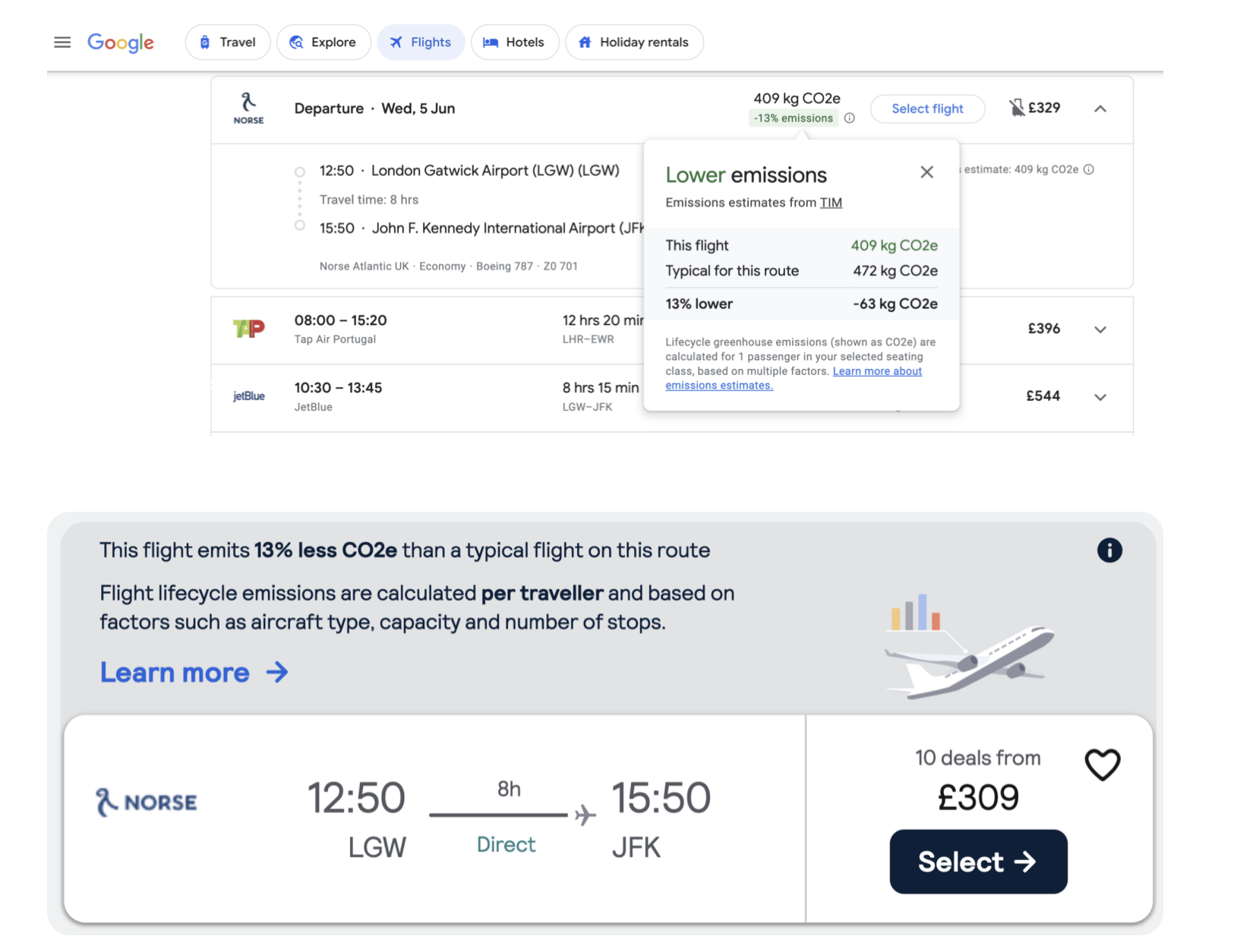
Major travel platforms and airlines teamed up with Travalyst to agree on a method for calculating and displaying emissions.
The model, known as the Travel Impact Model, estimates the emissions for the passenger, taking into account flight distance, aircraft type, cabin class, seat layout, and more.
The idea is to let travelers compare options side by side and potentially choose lower-emission flights.
Signs Are Emerging
There’s not yet public data from Travalyst and its partners on whether travelers are actually changing bookings based on emissions.
But there are early signs of impact, especially in corporate travel, where many companies are required to track and report emissions.
“One thing we can talk about so far is that Google and Sabre did a study looking at Sabre’s corporate emissions,” Farr said. Referring to changing things like the time of the flight and airline she added: “Optimizing flights, just doing some tweaks during the same day, could reduce emissions by 10%.”
That kind of insight, Farr said, is only possible through detailed emissions data, not broad averages.
“You need more granular reporting that shows over time that you’ve worked with your employees to reduce emissions by choosing, for example, lower-emissions flights.”
What’s Next: Rail, Reports
Travalyst says it will publish a report soon with insights from the data and hopes it can help inform decisions made by policymakers, travel companies, and businesses.
These insights could shape not just consumer behavior but also broader industry practices.
There are also plans to align data for many other aspects of the travel and tourism sector starting with accommodation, but expanding later into other areas such as rail, destinations and activities.
“We want to provide information around the carbon emissions of rail and accommodation so that travelers have a better picture of their options… and also so that corporations are able to report easily,” Farr said.
Skift’s in-depth reporting on climate issues is made possible through the financial support of Intrepid Travel. This backing allows Skift to bring you high-quality journalism on one of the most important topics facing our planet today. Intrepid is not involved in any decisions made by Skift’s editorial team.