How Commission Delays Can Cost Hotels Market Share and Future Agency Partnerships

Skift Take
New tracking tools are ushering in a new era of hotel-agency transparency. Lags in commission payments may determine whether hotel properties rise to the top of corporate booking tools and preferred supplier lists — critical channels for hotels in an uncertain economic environment when leisure travel is volatile.

This sponsored content was created in collaboration with a Skift partner.
Hotels have long measured distribution mix, the cost of distribution by channel, and ways to drive maximum distribution at optimal margins. Direct bookings often prove to be the most cost-effective, but third-party distribution continues to be far too valuable to ignore. According to Skift Research data, in 2024, about half of hotel customers said they preferred direct bookings, while 43% chose online booking platforms. Third-party distribution figures are even higher in the critical corporate travel sector.
Therefore, hotels have to focus on key factors that make them visible, especially if they’re smaller and independent.
With new tracking tools ushering in a new era of hotel-agency transparency, unpaid and aging commissions have become a powerful lever in partnership negotiations. Lags in commission payments may determine whether properties rise to the top of corporate booking tools and preferred supplier lists — critical channels for hotels in an uncertain economic environment when leisure travel is volatile.
In light of these factors, hoteliers recognize that working with third-party distributors and administering the associated commission payments are essential business strategies. However, as Onyx data revealed in a previous Data Snap, hotels are diligent about commission payments early in the year, but backlogs build up as demand peaks in the second half of each year. Historical data show that by Q4, unpaid commissions surge, creating a large gap between what agencies earn and what they’re actually paid.
Payment delays make it harder to forecast revenue, budget accurately, and maintain smooth client relationships. These year-end lags are seasonal inconveniences in a vacuum of any particular year, but they’re not just cash flow concerns for agencies — they’re trust signals for future partnership negotiations.
Commission Delays Are Open Records in a New Era of Transparency
Agencies now have access to hotel payment trends, which gives them visibility to benchmark KPIs alongside their peers. This new lens is changing the game. If one property consistently lags while its competitors pay faster, that hotel risks being deprioritized when agencies update their preferred supplier lists. Multinational hotel chains may be able to step in and rectify the issue with a member or franchise owner, but for independent hotels, a lack of action on commission payments may cause irreparable damage to their distribution network.
Comprehensive visibility into commission payouts creates a “trust index” for suppliers, where commission reliability — and accuracy — becomes a measurable KPI alongside rate competitiveness, location, or amenities. An additional layer of analysis may even reveal that certain hotel classes are more prone to low trust scores, providing agencies with sharper levers in shaping preferred supplier lists.
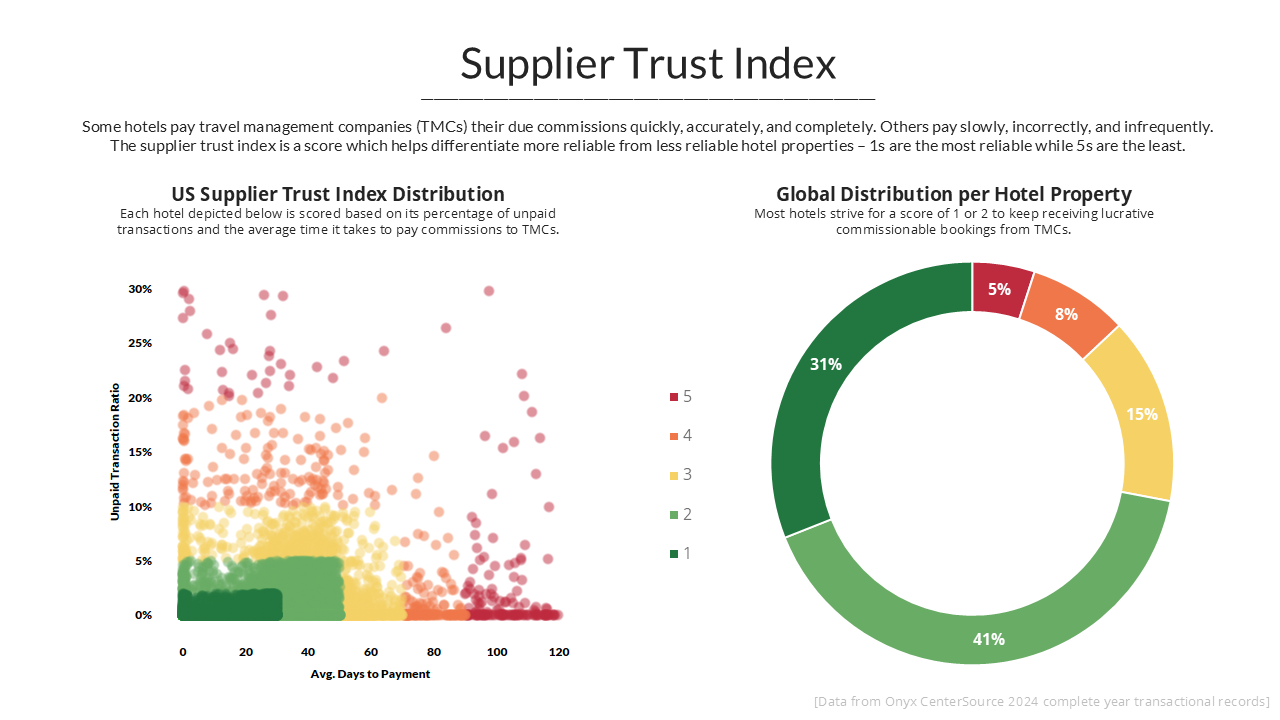
The agency community’s message is clear: Hotels that fail to pay on time risk losing market share in the next contracting cycle, even if their occupancy doesn’t suffer in the short term.
The Long-Term Cost of Commission Delays
Every percentage point of unpaid commissions translates into real negotiation leverage lost. Consider this: if a hotel underpays or delays just 2% of its commissionable transactions, it risks losing hundreds or millions in future agency-driven bookings as agencies steer volume toward faster-paying competitors.
With the Supplier Trust Index, agencies now have the visibility and rigor to shift bookings toward hotels that pay commissions reliably, creating an immediate incentive for suppliers to clean up payment practices. What was once hidden — unpaid transactions and long payment delays — can now be quantified, making it far easier for agencies to identify defaulters and reward trusted partners. The result is profound: a property, brand, or even an entire chain that ignores these signals risks losing hundreds of thousands, or even millions, of dollars in agency-driven business, while reliable payers stand to gain a disproportionate share of future demand.
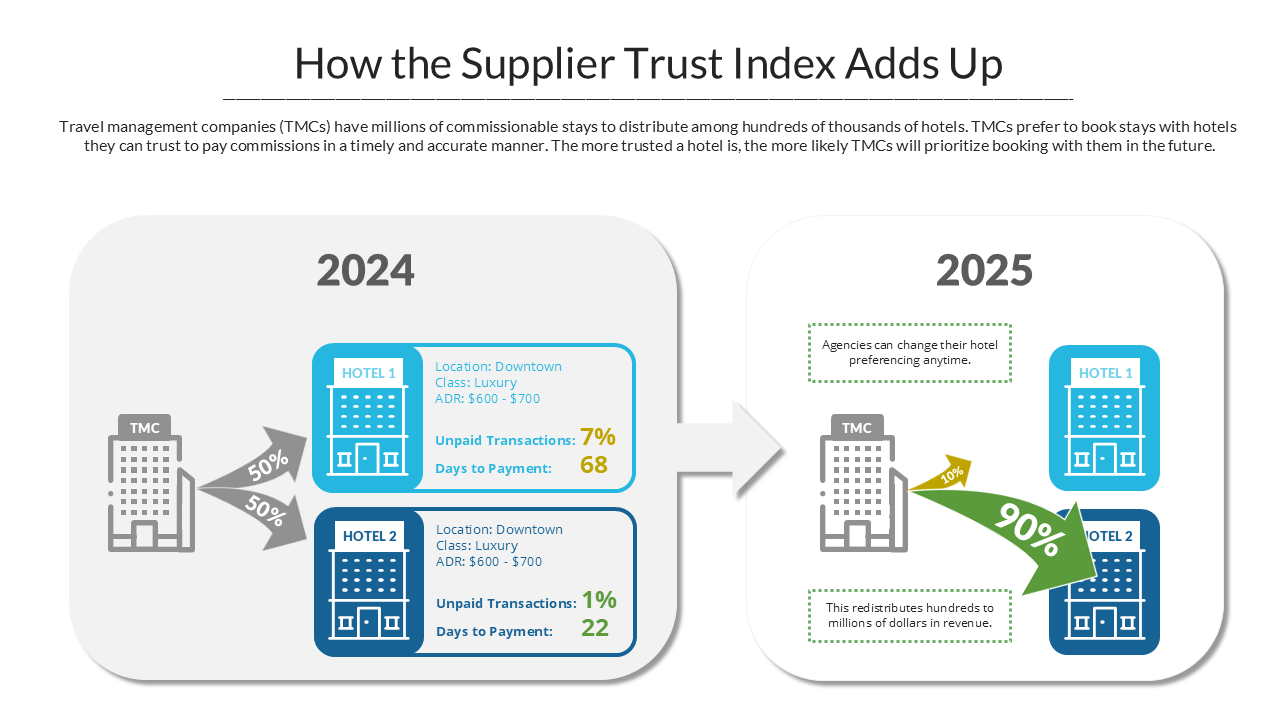
This reframes unpaid commissions from a back-office task into a strategic risk with direct revenue implications.
When Unpaid Commissions Become Tomorrow’s Negotiation Currency
Agencies are actively consolidating their supplier base, giving a larger share to those partners who pay reliably and on time. Late payers are increasingly impacted by preferencing strategies in corporate booking tools, and sometimes via agent booking strategies, biasing suppliers based on their payment performance — a shift that amplifies the impact of delayed commissions far beyond back-office operations.
It’s equally important to recognize that many chains have embraced this reality, investing in centrally managed solutions to ensure timely, consistent commission payments. These proactive approaches not only prevent negative downstream impacts but also demonstrate how payment reliability can be turned into a competitive advantage in winning and retaining agency share.
Connecting the Dots: Why Avoiding Commission Delays Matters More Than Ever
Across previous Data Snap analyses, the data highlighted how elements like funding structures, booking modifications, cancellations, loyalty-driven direct bookings, and data quality all influence hotel–agency relationships. Together, they form a complex ecosystem of trust, efficiency, and profitability.
Layered onto this is yield. Commission reliability is not only a trust signal but also a yield driver. Properties with consistent payment behaviors capture stronger ADR performance — in fact, commissionable ADR has been on average 56% higher than non-commission ADR. This illustrates that reliability in commission payment isn’t just about smoothing agency relationships; it directly correlates with revenue outcomes.
Unpaid commissions may be the most critical piece of the puzzle. They represent the ultimate signal of partnership reliability, which is critical for agencies, given the significance of this revenue stream to the agency segment. Unlike rate strategy or booking channel mix, which fluctuates with market conditions, payment reliability is a consistent behavior — a true reflection of how a hotel values its partners.
In an industry where margins are thin and relationships drive revenue, hotels need to prioritize commission reliability and actively use insights like OnyxInsights’ Market Share dashboard to benchmark agency behavior, which allows hotels to track in real time whether a particular agency has deprioritized them and shifted volume toward competitors.
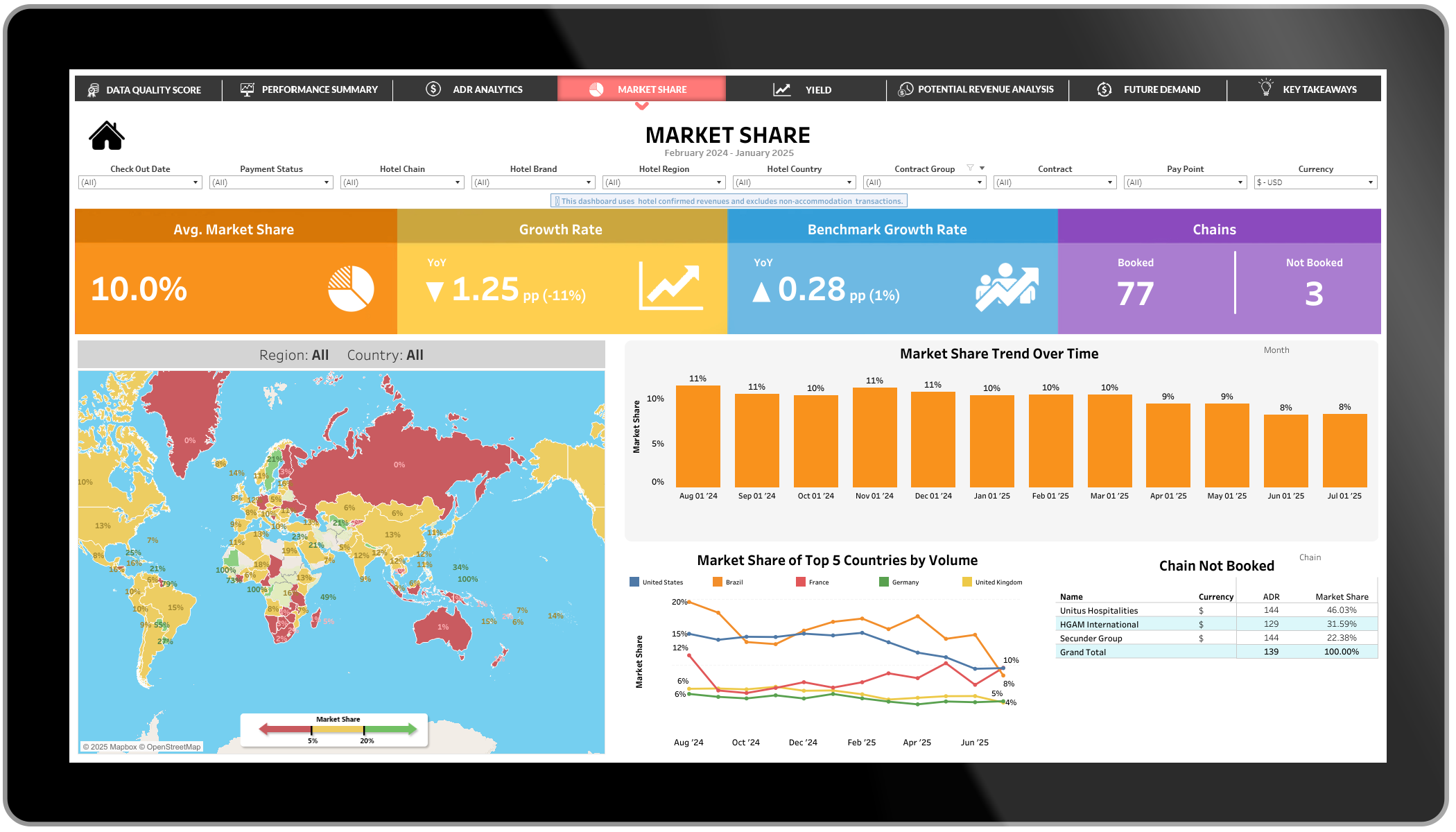
Commission payments have moved far beyond back-office accounting. They’ve become a strategic signal that agencies measure, compare, and use not only to set their supplier targets and optimize supplier negotiations, but also to create pricing strategies for their end customers. By monitoring these movements, hotels can not only spot early warning signs of lost share but also use this intelligence to address issues before they cascade into the next contracting cycle. When successful, they’ll find themselves not just on the books, but at the top of the list.
“The Data Snap” is a recurring article series that paints a clearer picture of the dynamic hotel booking landscape, empowering hotels and agencies to make data-driven decisions that help them build productive partner relationships and drive more revenue.
OnyxInsights offers a comprehensive view of the industry landscape, enabling hotels and TMCs to make well-informed decisions and better serve their clients and partners. Onyx CenterSource processes over 100 million transactions annually on behalf of 200,000 agencies and 150,000 hotels globally, representing nearly $2.1 billion in hotel commission payments. Visit onyxcentersource.com to learn more.
This content was created collaboratively by Onyx CenterSource and Skift’s branded content studio, SkiftX.