American Airlines and the Modern Passenger Experience — Full Video

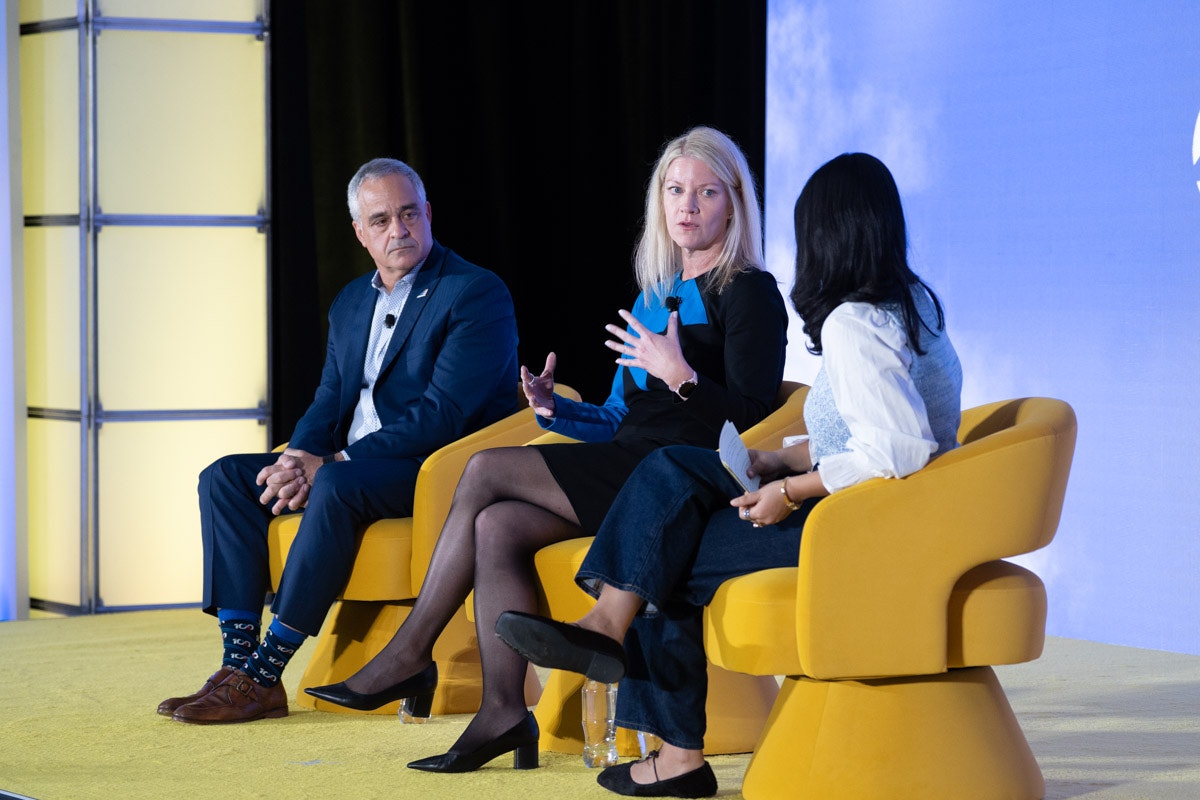
Photo Caption: David Seymour and Heather Garboden of American Airlines, speaking at Skift Aviation Forum in Fort Worth, Texas on December 3, 2025.
Skift Take
American's premium bet looks smart now, but hinges on luxury demand surviving the next economic downturn.

American Airlines executives outlined the carrier’s strategic focus on premium travel and operational technology at the Skift Aviation Forum in Dallas, Fort Worth, while addressing a turbulent year for the industry.
Chief customer officer Heather Garboden and chief operating officer David Seymour emphasized American’s commitment to expanding premium offerings, with plans to add 30% more premium seats by decade’s end and 50% more on long-haul flights.
On operations, Seymour highlighted artificial intelligence tools that have transformed the airline’s ability to handle disruptions. American’s HEAT system has reduced cancellations at Dallas-Fort Worth by 90%, he said.
The executives discussed continued investment in the travel experience, from new aircraft interiors to expanded lounge offerings and food partnerships with brands like Bollinger and Lavazza.
Watch the Conversation
Full Transcript
Announcer:
Please welcome the Chief Operating Officer at American Airlines, David Seymour, and the Senior Vice President and Chief Customer Officer at American Airlines, Heather Garboden, in conversation with Skift Airlines reporter, Meghna Maharishi.
Meghna Maharishi:
So David, Heather, it’s so great to have you here with us today to kick off this session. So I do want to get started with some of the hard things that have happened this year. I think we can all say that 2025 has been a particularly tough year for aviation.
We had two tragic fatal plane crashes, one of which American was involved in, and we also had a 43-day-long government shutdown. We might have another one in two months, and we also still have an air traffic controller shortage. So David, I just want to start with you. What has it been like handling a lot of those hardships as a chief operating officer?
David Seymour:
Again, good question. And certainly I’ll tell you it’s, I think the way I kind of characterize it’s a year of firsts. We’ve had a lot of first time events that we have, but I think that’s with 26 years in the industry, you deal with a lot of the unknown, a lot of the uncontrollable. But it has been a tough year, particularly with the accident, tragic accident at the end of January involving one of our regional carriers. But I tell you, it’s really given me a lot of hope of what our team can do. And all through this process, it’s all been focused in on taking care of our customers, taking care of our team members. And that has been a lot of the focus.
And these are, as we’ve been through the events, the shutdown, other events that have happened, we’ve really, I think, set ourselves above all of our peer sets in terms of how we recover. And it’s a recovery that’s based on a customer focus. And a lot of our work is doing that. But that’s what we’re set for. I mean, this is industry I’ve been in, like I said, 26 years and you learn to control the uncontrollable and you do it really well.
And but I couldn’t be prouder of what the team has done through the year, but they’ve been doing this for several years doing this. It’s just been definitely a more challenging year that we’ve had. But yeah, every time we come up, and I talk to our team when I go out and I spend a lot of time out in the operation and every one of them will tell me we’re recovering better than others. We like the fact that when we have an event, we work it customer focused on what we’re going to deliver, making sure that we’re ensuring that they’re aware of what’s happening. But the next day, we’re back to normal.
Meghna Maharishi:
Yeah. And I mean, do you feel concerned that we might have another government shut down maybe come January 30th?
David Seymour:
Again, I’m not going to kind of speculate on what’s going to happen. My hope is that we don’t, but what I’ll tell you and what I said during the shutdown that we had, it’s just not right. We shouldn’t be going through this. We should not be putting the traveling public through this. We shouldn’t be putting our team through it because it creates a lot of uncertainty. And when our passengers buy tickets on American Airlines, we’re making a promise to them that we’re going to get them there. And that’s what we need to do. We need to be able to provide them certainty.
My hope is during this time right now that we can actually get the government to say, “If we’re going to have some of these shutdowns, let’s pay our air traffic controllers.” So it’s not just the air traffic controllers. It’s all the federal aviation workers. So it’s our TSA agents. They had the same issues that they went through and I got to give a lot of credit to our air traffic controllers, our TSA agents, CBP, anybody that was a government employee that was coming in and working without a paycheck, a lot of credit for what they did because they really stood up.
I can’t imagine what that’s like, knowing that you’re going to get the money, but you don’t have the money. And money is what’s going to buy, put groceries in the house, on the table, pay the rent, pay the car bills and all that. But my hope is that the government, and that’s some of the work that we’re trying to shoot for, is make sure they can be paid during the shutdown. Because it’s critical to the United States, it’s critical to our economy that they keep that going.
Meghna Maharishi:
Yeah. I guess, we’ll see where we are in January. And also just to the audience, if you have any questions, feel free to put them in the Skift app and we’ll try to get to some of them or so towards the end of the session. I do want to shift a bit of our conversation to premium.
I feel like that’s been maybe the word of the year in the airline industry. And Americans seems to really be undergoing a pretty big premium shift right now. I’ve been seeing Champaign is back in business class. You have this partnership with Lavazza serving Italian coffee. I’m wondering if maybe you both can speak to a little bit more about this shift that’s been happening at American.
Heather Garboden:
Sure. Yeah. I think I can start.
David Seymour:
You can start, yeah.
Heather Garboden:
And David can chime in. But I think even before COVID, we saw a younger generation starting to be a larger demographic of our customer base. And I think we know that they’re willing to pay more for experiences and differentiated experiences. And so premium demand has definitely been something that has been incredibly strong. Even in, as you mentioned, kind of some uncertain times, uncertain economic environment over this last year, premium demand has been really strong. And so we’ve been focused on this for a while.
We’ve had a lot of exciting announcements this year, but when you think about our fleet, I mean, we just launched our 7, 8, 9 Ps, which P stands for premium. More than a third of those seats are premium seats. We have our XLRs that we’re going to launch next week, which is incredibly exciting. The interiors, the feel, the look of those aircraft are really nice and we’re going to be expanding that to our 777-200s and 300s. And so I think as it pertains to our wide body fleet, we have the best product as you think about a premium experience for long haul flying.
And so we’re excited about that. You touched on food and beverage. That is, of course, everyone likes to have a good food and beverage experience. And we partnered with Bollinger to be our champagne partner. That’s in all of our flagship lounges. It’s also on all of our flagship flights as well. And Lavazza, we’re super excited about as well. And we’ll continue to do more of that. I think when customers are flying, they want to have food that they know, that isn’t different, that’s comforting, and hopefully healthy sometimes. So we’re definitely focused on the food and beverage aspect.
And then of course lounges, I mean, there’s nothing that is more premium than some of the lounges that we have out there. And we’ve had the flagship lounges out there for almost a decade. And so we’re excited to have the most number of premium lounges than any other airline in the US and we’ll continue to expand. We just announced that we’re going to open a new Charlotte Flagship lounge. So we have a lot of exciting things happening, a lot of momentum going, and we feel really good about where we’re at with our premium focus. And of course, there’s always still more to do. Yeah.
David Seymour:
Yeah. And I’ll add into it. And I’m really excited about where we’ve… Our approach to adding premium, but really the customer experience is with Heather’s position. Because the position really is starting to bring our commercial and our operating teams together. I think that’s the insight that we really have is that we have to design it, we have to deliver it. And that’s the key. And so her team is really spread between our commercial and our operations team and how we pull that data and knit it together. Because the most important thing for our customers is we say we’re going to do it, we got to do it.
And I’m really excited about the work that we’re doing because it is the premium, but it’s also other things that we’re doing out there in terms of providing better technologies for our customers to use. We’re also working with the government agencies really excited, particularly here. We’re in the DFW area at the airport is working with the One-Stop, which is a very unique experience for those to have the opportunity to do it. But it’s a partnership with the UK government with CBP and TSA where our customers coming in from London Heathrow can, if they’re connecting through the DFW airport, don’t have to go through bag reclaim, recheck, or TSA.
They connect like they’re connecting from a domestic flight. So there’s partnerships like that that we’re working through with TSA, with Touchless, with CBP, with the EPP, where you’re getting wait times now, clearing customs, or passport control that are measured in 10 minutes versus what we’ve in the past have seen couple hour waits in some locations. So it’s looking for all those opportunities that we have. So it is a premium, but it’s also, I think, a premium experience for everybody on board the aircraft.
Heather Garboden:
And we’re also, we’re looking at growing our seat capacity. We’re going to have 30% more premium seats by the end of this decade and 50% more premium seats on our long haul flights by the end of this decade. So a lot of what David was talking about, I mean, it all comes together. And yeah, I think especially we’re already in a really good spot. Over the next couple of years, we’ll be even better.
Meghna Maharishi:
Yeah. And during American’s last earnings call, CEO Robert Isom said American is a premium carrier to begin with and we’re only going to become more. I think there might be some people who might disagree that American is at least currently a premium carrier. Could you tell me why they’re wrong?
Heather Garboden:
Yeah. I think a lot of the points that I just mentioned. I mean, I think if you look at our premium wide body experience or long haul experience, we have an unbelievable product. As you look at lounges, we have more premium lounges than any other airline in the United States. We started the premium lounges and we’re only looking to expand them. And I think overall, the premium experience at American is as good or better than any of our peers. And of course, we’re always looking to improve that and we’re always focused on different opportunities.
I think, especially on the lounge front, we’ve had incredible, really exciting announcements over the last six months. We are expanding our lounge capacity and a lot of our hubs, we are opening or updating and expanding our flagship lounges, which is our premium lounges and several of our hubs. And I think you’ll see us continue to have a really good steady stream of exciting lounge announcements over the next year, I would say.
And so that’s only going to continue. And as I touched on on the food and beverage side, we have really good options and products there. We are focused on partnering with regional chefs and restaurants. And in Philadelphia, we just opened our latest flagship lounge and we have one of the local chefs through the James Beard Foundation that provides several of the dishes. We have healthy options. We have Philly Cheesesteaks, the food, the feedback has been incredibly positive. We also have a vegan Philly Cheesesteak, which actually is-
David Seymour:
They’re good.
Heather Garboden:
… is very good. I’m not a vegan, but. So yeah, no, I think that we have launched several really exciting initiatives like the 789-P, like the XLRs that had been years in the making and we’re only going to continue that. And as I touched on, we’re also expanding our premium seating. And so I think that we are definitely competitive in the premium landscape and will continue to get better.
Meghna Maharishi:
And I do want to follow up on lounges. I feel like lounges have just become a really big part of the customer experience and we also have some pictures of American’s lounges here. I’m curious, how exactly do you think about making those lounges premium? And I don’t know, maybe could we expect to see something like a Delta One Lounge, but an American one in the coming years?
Heather Garboden:
Yeah. Yeah. Yeah. Well, I will say that the lounge game, I always say it’s totally different. I mean, if you look at a decade ago, a lounge was where you went to have a cup of coffee and a snack. And so it definitely has changed. And I think we really kind of started that with our flagship lounges almost a decade ago. And so these are photos of our Philadelphia flagship lounge.
If I encourage anyone to check it out, it’s incredibly nice. It’s elevated. We have really nice food and beverage offerings. And I think that our product, we started several years ago and we’re going to continue to update and improve over time. And Delta, I know, has just launched theirs. So a lot of it is just timing of when new lounges open. And so yeah, I think that we have almost 50 Admirals clubs throughout the country and throughout the world.
We have nine premium lounges with… Or eight premium lounges with one more to come in the next year or two. And so yeah, I feel our lounges are incredibly good product. We’re focused on how we can expand food and beverage. I think now when you go into a lounge, the expectation is that you can order an à la carte menu. And we’ve started that with our latest flagship lounge and we’ll continue to do that with, and expand that to our other flagship lounges as well.
Meghna Maharishi:
Yeah. And also, it seems like that’s also been just getting more and more competitive in the space.
Heather Garboden:
Yeah.
Meghna Maharishi:
Every airline trying to be more premium than the other.
Heather Garboden:
Yeah.
Meghna Maharishi:
And I want to turn to both of you on this. So with all these investments that American has been making and a lot of other, your competitors are also making these similar sorts of investments, typically they take a lot of time for those results to be fully materialized.
I think like two of American’s biggest competitors seem to have really started leaning into premium, maybe more so in the 2010s. So I’m kind of curious, with some of these changes that are going on in American, what sort of lift to American’s bottom line do you expect to see and when do you expect those results to fully materialize?
Heather Garboden:
Yeah. I think we believe at American that, of course, you want to have the best customer experience, the best brand loyalty, customer sentiment that you can possibly have. And we believe, I think our, others in the industry believe that improved NPS scores, which is kind of the industry standard for customer sentiment, that that drives value and that can drive a revenue premium.
And so while it’s not as black and white as potentially a technology investment or driving headcount efficiencies, we 100% believe that the investments in our customer drive revenue and improve the bottom line overall. So we’re excited about what we’re doing and feel really good about it.
Meghna Maharishi:
And do you have, is there a ballpark as to when and as to how much maybe American expects to collect in terms of revenue from a lot of these new investments or?
Heather Garboden:
Yeah. I mean, I think that these are ongoing investments, like I mentioned. A lot of the initiatives like the 789-Ps, the new aircraft that we’re launching, I mean, those are years in the making. And so I wouldn’t say a specific number here, but I think across the industry, it’s pretty standard to feel like a point of NPS improvement is anywhere from 50 to 100 million in improved revenue. And so we’re really focused on making sure that we have the best customer sentiment and NPS scores that we possibly can. Yeah.
Meghna Maharishi:
Yeah. And I kind of want to shift to sort of the broader industry conversation. Obviously premium has been very big, but there’s also just been a lot of economic uncertainty this year when tariffs first came to be in around March. And I think it’s also fair to say that there is a pretty big affordability crisis in the United States right now.
It’s been front and center of our politics. Also, the rich have maybe only gotten richer these past few years. So I’m curious, maybe just among both of you, in your view, why do you think premium is going to be so resilient in the years to come? And do you think that maybe there could be a reckoning on some of this at some time?
Heather Garboden:
Yeah. I mean, I think that we have seen, as I mentioned, premium demand has really held up through these uncertain economic times. I certainly cannot tell you what’s going to happen over the next five or 10 years, especially in the airline industry. It’s very, very dynamic. Hard to know what’ll happen in the next five or 10 months. But that’s why while premium is definitely a focus for us, it’s not our only focus. And we are here to take care of all of our customers.
We have, I would say, what’s a mid-tier premium product, like our premium economy, which is honestly one of my favorite products that we have at American. And we’re also looking for enhancements that are for all customers, like expanding our buy on board programs for food and beverage. We will be launching complimentary wifi next year for all AAdvantage members and we’ll have more free satellite-based Wi-Fi on our aircraft than any other airline in the entire world. So while I think premium demand is kind of the focus right now, I have no doubt that whether that changes over the next decade or so or it doesn’t, we also are focused on all customers, not necessarily just premium.
Meghna Maharishi:
And I guess David, this is maybe more for you. American has had quite a few changes to its C-suite over the past year or so. And also, I feel like American previously seemed to have a more domestic focused strategy in what it was going for. That seems to have pretty much changed into a more premium and international one. I’m kind of curious, why do you think maybe some of those maybe more domestic focus strategies are not working so well right now, maybe in the industry and also for American?
David Seymour:
Well, I think the way I look at it is, I mean, some of our international focus has, as we have less international aircraft than our competitors, but part of that is related to delivery delays from our manufacturers that allowed us to get into both the 7, 8 Ps that Heather talked about were significantly delayed. Our XLRs were delayed as well. They’re now here and we’re starting to see that stream come through.
So that’s put us back. And we also, over the COVID period, retired a couple of fleets, so we could rationationalize the fleet, which has created a huge opportunity for us in terms of how we manage our pilot resources across two narrow body fleet types, two wide body fleet types. And we’ve seen the benefit of that in terms of how that’s reduced some of the pilot training requirements that we have because there’s less movement that they have to move around and there’s a lot more availability for them to move to different hubs if they want to do different types of flying.
But again, we have a larger domestic focus than anybody else. We have a larger regional network than anybody else that is able to provide feed to all of our hubs that we have throughout the country. But again, I think what’s happened this year has created some uncertainty for the more price sensitive customers, but we’re still seeing the volume out there of people coming in. But we’re very focused on that domestic network in our hub and spoke to be able to feed what we have.
Meghna Maharishi:
Yeah. And I do want to switch gears and touch on a topic that I think is going to be discussed quite a bit throughout the day, and that is AI. So David, I’m kind of curious, maybe could you tell me about an instance where AI has been maybe groundbreaking or very helpful for some of American’s operations? And maybe how are you thinking through integrating that technology or, I don’t know, do you think maybe the technology is over hyped?
David Seymour:
Oh, I don’t think it’s over hyped. I certainly don’t, but we only have five minutes I think left, so I don’t know if I have all the time to talk about, but it’s more than one. We’ve been working with AI in our operation for quite some time and have a number of use cases. We have tools that we use to manage overall system operations. Something, the approach we’ve taken probably a little over now pushing almost four years of how we manage our operation when we have disruption. And one of the tools that we have, and we’ve talked about it extensively, is a tool that we call HEAT.
It’s our Hub Efficiency Analytics Tool, and it manages our flow. So again, when we get into weather events and the FAA decides that they’re going to put in some sort of traffic management initiative, a ground delay program, groundstop or a mix of those, that’s very disruptive to our system because we don’t get a lot of notice. It comes in and I think it’s kind of that it’s doing surgery with a chainsaw. We with this HEAT tool can layer this in and start working on it about seven hours in advance and build our schedule so we can delay through the schedule.
So it does pose delays for our customers, but it keeps the schedule intact. We’ve been able to reduce cancellations here when we first start using DFW by 90% and it keeps everything together. It keeps our crews together, keeps our customers together, but more importantly, it lets our customers know in advance. So we’ll provide them advanced warning that their flights are going to be delayed.
We might, in some cases then with other tools that we have, give them reroute options so they can still get to their destination. So those are tools that we’re having. I mentioned earlier about how I honestly believe that we have the best recovery of any airline. We’ve now used those tools in our crew recovery. The key, if you look at major disruptions that have been around the system, and for some airlines that have struggled with it, is they lose track of their crews.
We don’t do that. We have major events in which we repair our system within hours and we’re back to operating. And so you look at the, I think probably the most notable one we had was CrowdStrike. I know that’s a couple summers ago, but we were repaired within less than 24 hours. No more cancellations related to CrowdStrike, and we were as equally impacted as any other carrier. So those are the tools we have. We have more of them going out that are working into our maintenance organization, how we route aircraft, but I think there is a lot of opportunity and we are taking advantage of that opportunity incorporating into our systems.
Meghna Maharishi:
And I feel like also with AI, one of the things that has been a concern are jobs. I mean, do you expect American to shed its headcount because of AI?
David Seymour:
No, I don’t at this point. Because we’re still in development on some of these, but what it’s going to do is it’s going to make those team members, whether, because we’re going to use AI in our airport operation, it’s going to make them more efficient on how they’re do it. So it’s going to allow us to provide a better product to our customers. Okay, that’s what we’re really looking at right now.
Down the road, could there? I don’t know. But at this point, it’s not a focus on how we get rid of jobs. It’s a focus on how I provide a better customer experience. And what I want to do in a customer experience is provide a better team member experience in terms of how they’re able to deliver the job. We have to set our team members up for success in delivering that customer experience, and that’s our focus right now.
Meghna Maharishi:
Yeah. I do want to get to some of the audience questions just because we have a couple minutes left. So here’s one. This is for you, Heather.
Heather Garboden:
Yeah.
Meghna Maharishi:
What is your new customer experience org tasked with accomplishing in 2026? And can you share any early wins? How will their input drive further change to your fleet?
Heather Garboden:
Yeah. So I think our team, our focus is taking care of the customer from end to end. So we’re looking at the entire customer journey and how we can make it as smooth and seamless as possible. And that requires coordination, as David touched on, from basically every single, or every single team in the entire company, especially the operations team. And so we’ve had several wins this year. We’ve opened our latest flagship lounge. We’ve launched two premium aircraft, or we’ll launch our second one next week. We have upgraded our amenity kits. We’re expanding.
This is, I mean, I guess not public till next week, but we’re expanding mattress pads on all of our business class flights, which is a huge deal. We want our customers to be able to feel comfortable when they’re flying. We have our champagne and coffee partnerships. So we have done a lot this year. I think as we go into 2026, my focus for sure is ensuring that when things don’t go as planned, because we know even on a perfect day for any airline, you still have thousands of customers that have a different experience than they had expected, whether it’s a 10-minute delay or an hour delay, even on the perfect day.
And so we need to make sure that we have the best possible tools and communication for our customers. And that means both within our digital tools, our app, as well as making sure that our team members have all of the information so they can communicate that to our customers. And we’re starting to launch a piece of that by the end of this year, which I feel super excited about. And we’re going to be in a really good spot with that over the next six months. And so that to me is definitely one of our top priorities, as well as continuing to focus and enhance on the premium experience, which I will continue to our momentum of some exciting announcements into 2026.
Meghna Maharishi:
I do want to get to one other audience question. What is the most important metric when thinking about airport experience for your guests?
Heather Garboden:
Yeah. So I think I mentioned NPS. That’s kind of a standard metric that is across the entire experience, but we have really good customer insights and data. We survey our customers, whether through our app or through email, and we’re able to get a lot of really good feedback on what works and what doesn’t work.
We also have focus groups with team members and customers to tell us what works and doesn’t work for them. And so we’re always looking at what is the most meaningful area and has the most impact to improving customer experience. And of course, an airport’s a part of that. And so yeah, we have really good insights.
David Seymour:
Yeah. And I’ll add to that. I mean, the NPS data that we get is actually now appearing on our dashboards that our leaders at the airport get and our frontline team. So they’re seeing. So gate agents can see how they’re doing. And it allows us, because as I say, once you’ve been to one airport, you’ve been to one airport. They’re all different.
And so we’re using that data now at a local level to look at what are the top drivers of negative NPS and what can we do to improve on that? And we’re seeing some really great shifts in that experience at the airport, whether it starts in the lobby or even on the curbside working its way all the way through security, all the way to the clubs, the gates and all that. But there’s a lot of focus on how every individual, every team member at American Airline can have an impact on NPS.
Meghna Maharishi:
And I do know we’re out of time, but to wrap up, I do want to ask both of you, maybe just in one sentence, if each of you could answer, what are your hopes and dreams for American in 2026?
David Seymour:
Well, I think it’s to continue the journey that we have on customer experience. I think the whole team is super excited about where we’re going, this investment that we’re making here. You can feel it out in the operation. And I spend a lot of time out in the operation talking to them and the energy’s there, the excitement is there. And I’m really excited about continuing the journey that we’re on right now.
Heather Garboden:
I would say to be the number one choice for customers when they fly. We have the best loyalty program in our AAdvantage program and look forward to continuing to provide enhancements for our customers.
Meghna Maharishi:
Yep. David and Heather, everybody. Thank you.
Heather Garboden:
Thank you.